
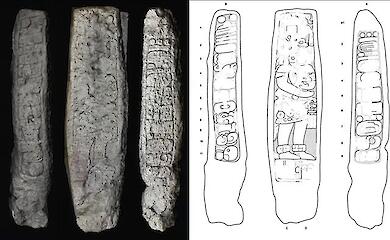

Archaeologists have revealed why the Mayans returned to abandoned altars


Ancient Maya cities may have been abandoned, but they did not become an empty place for people. Archaeologists have found that centuries after the decline of major Maya centres, the Maya continued to return to old monuments, put offerings and rituals nearby.
The new findings were made at two monuments in northwestern Belize - Kaxil Uinik and Ayiin Winik. The researchers described traces of late postclassical rituals at the old steles, as well as the first known for this region altar of this period. It is not a large temple, but a small stone structure made of limestone blocks.
The main intrigue of the find is that the Maya probably did not live there permanently. They came to places that were already part of the past and re-incorporated them into their ritual life.
Details
The study concerns the period after the decline of many Classic Maya centres. In the Three Rivers region of northwestern Belize, large settlements were largely abandoned by the end of the Terminal Classic period, around the ninth century. However, later, well into the Postclassic period, people continued to visit some former urban centres.
The archaeologists studied two sites, Kaxil Uinik and Ayiin Winik. They looked at how the stelae were arranged, where the pottery fragments lay and what types of vessels were found. From these signs, the researchers concluded that the late visitors were not just passing by, but were performing ritual acts.
At Kaxil Uinik, scientists re-examined Stela 1. It is an ancient stone monument, broken into pieces. Around it they found 24 fragments of late postclassical Chen Mul-type smokers. One of the fragments was in the form of a realistic face and probably dates back to colonial times. The position of the stela and finds suggested that later visitors re-installed part of the monument and left offerings nearby.
At Ayiin Winik, the find was even more evocative. Next to Stela 1, archaeologists found a small pile of limestone blocks about 125 cm in diameter. At first it was mistaken for the fragments of a monument, but then it became clear: it was probably a late Postclassic altar. Around and on top of it lay fragments of ceramic smokestacks.
Smokers were an important part of rituals: they could burn aromatic substances, the smoke of which had sacred significance. For archaeologists, such fragments are one of the main signs that people came here not for the sake of ordinary life, but for the sake of ritual.
Simply put, the Maya did not return to old monuments as tourists or as builders. They came to places that remained strong in the memory of the community. Old stelae and ruined structures could be seen as a connection to ancestors, past power, and a sacred landscape.
Why it matters
This finding shows that an "abandoned city" was not always a dead city. Even if people no longer lived there permanently, the place may have remained important. It was revisited, it was reinterpreted, and new ritual points were created next to ancient monuments.
For Maya history, this is an important detail. Often the decline of classical centres is described as an abrupt end. But archaeology shows a more complex picture: the political system may have disappeared, the population may have left, but the memory of the place continued to live on.
The authors of the study believe that the actions of later visitors fit into a wider custom of honouring ancient and long-established sites in an abandoned landscape. People may have re-installed monuments, left offerings, and thereby gave meaning anew to symbols of former authority.
Background
Classic Maya civilisation experienced a serious decline sometime between the 8th and 10th centuries. Many cities in the Maya lowlands were abandoned, and previous forms of authority and large public rituals weakened.
But religious practices did not disappear. During the Postclassic period, which is usually dated from 900 to 1542, people could come to caves, hills, old buildings and monuments. There they would leave offerings and sometimes build small altars of stone.
The new work refines this picture for northwestern Belize. There were already known examples of late monument veneration in the region, but Ayiin Winik has provided the first described Late Postclassic altar in this particular study area.
There is a limitation: dating is largely based on pottery types. Such a method is useful, but does not always give an accurate date. The authors are therefore cautious about Late Postclassic visitation and note that the chronology of such finds needs to be clarified.
Source
Research: Victoria A. Ingalls, Brett A. Houk, A Late Postclassic Altar and Evidence of Monument Veneration at Two Maya Sites in Northwestern Belize, Journal of Latin American Antiquity, 2026.
An independent researcher, interested in archaeology and sacred geography. He researches them and writes about them.
Related news
Scientists have discovered how crested geese were bred in the 17th century

Scientists have discovered why one brother was buried in a lavish grave whilst the other was buried on the outskirts of the cemetery
Scientists have discovered why the Incas sacrificed children
Archaeologists have discovered an ancient curse containing the names of enemies and demons
Popular news
A medieval bathhouse in Morocco has kept its secret for a thousand years
Scientists have discovered why one brother was buried in a lavish grave whilst the other was buried on the outskirts of the cemetery

Astronomers have detected a signal that has been travelling towards Earth for over 8 billion years

News about war

Ukrainians have to help wounded during Russian shelling on their own


Pro-Russian march with St. George ribbons and Night Wolves allowed in Vienna

"Grow up!" - Budanov named the main risk for preserving independent Ukraine

