

Asteroid that killed dinosaurs could help fungi take over ecosystems


An asteroid that hit Earth some 66 million years ago was a disaster for dinosaurs. But for fungi, the consequences could have been very different. A new study shows that the number of fungi on the planet may have increased dramatically after the impact.
The reason is simple. After the global catastrophe, a huge number of plants and animals died. Forests were destroyed, ecosystems changed, and dead organic matter became food for fungi - the main natural "recyclers".
Scientists have found traces of such a mushroom boom in ancient rocks of North America. This strengthens the theory that after the extinction of the dinosaurs, fungi may have become a particularly important part of the destroyed ecosystems for a while.
Important: The study doesn't say that mushrooms killed the dinosaurs. The main cause of the catastrophe remains the Chicxulub asteroid impact. It's about the fact that after the impact, fungi could quickly take advantage of the consequences of this "end of the world".
Details
The researchers studied sedimentary rocks in Colorado and North Dakota. They were interested in layers that formed shortly before the asteroid impact, during the very boundary between the Cretaceous and Paleogene periods and immediately afterwards.
In these layers, scientists looked for microscopic remains of fungi - spores and other traces preserved in the rock. To avoid destroying the fragile samples, they used a gentler way of preparing the material than standard acid methods.
The results revealed two important episodes. First fungal growth began even before the asteroid impact - some 30,000 to 10,000 years before the catastrophe. The authors attribute this to climate changes that may have been caused by powerful eruptions of the Deccan Trapps in what is now India.
The second, more noticeable uplift occurred after the asteroid impact. When dust, soot and aerosols got into the atmosphere, the so-called shock winter began on Earth: there was less sunlight, plants died en masse, food chains collapsed.
For many animals, this was a death blow. But for fungi, which feed on decomposing plant and animal remains, this situation could create a huge source of food.
That's why researchers saw a dramatic increase in fungal microfossils in the layers after the disaster. They believe this suggests that the fungi were actively growing in a world that was full of dead wood, leaves, and remains of organisms.
Why it matters
The end of the dinosaurs is usually told as a catastrophe: an asteroid impact, darkness, cold, the death of giant reptiles. But any mass extinction is not just the story of those who disappeared. It's also the story of those who survived and were empowered.
Fungi may have played an important role in the planet's recovery from the impact. They decomposed dead organic matter and returned nutrients to the soil. Without such "sanitarians," destroyed ecosystems would have recovered differently.
The study also shows that life on Earth did not react to the crisis overnight. It seems that ecosystems began to change even before the asteroid impact, against the background of volcanism and climatic shifts. And the impact itself was the final and most powerful push.
Background
The mass extinction at the Cretaceous-Palaeogene boundary occurred about 66 million years ago. It was then that the non-avian dinosaurs disappeared, and with them - a lot of marine and terrestrial organisms.
The main event is considered to be the fall of the asteroid Chicxulub, which left a crater on the territory of the modern Yucatan Peninsula. But scientists have long debated the role of the Deccan Trappes - giant volcanic outpourings in India that could have influenced the climate even before the impact.
Mushroom "outbursts" after global crises are already known to palaeontologists. They are particularly well described after the Permian-Triassic extinction event about 252 million years ago. The new work shows that a similar scenario could have happened again after the catastrophe that ended the dinosaur era.
Source
Rosanna P. Baker, Arturo Casadevall, "Fungal proliferation before and after the Cretaceous-Paleogene mass extinction event in North America," Proceedings of the National Academy of Sciences, 2026.
In the study, scientists examined ancient sedimentary rocks from North America and found evidence of an increase in fungal microfossils before and after the extinction event at the Cretaceous-Paleogene boundary. The authors suggest that the first increase could have been related to climatic changes due to volcanism, and the second to the effects of the Chicxulub asteroid impact.
An independent researcher, interested in archaeology and sacred geography. He researches them and writes about them.
Related news
Scientists have discovered how crested geese were bred in the 17th century

Scientists have discovered why one brother was buried in a lavish grave whilst the other was buried on the outskirts of the cemetery
Scientists have discovered why the Incas sacrificed children
Archaeologists have discovered an ancient curse containing the names of enemies and demons
Popular news
A medieval bathhouse in Morocco has kept its secret for a thousand years
Scientists have discovered why one brother was buried in a lavish grave whilst the other was buried on the outskirts of the cemetery
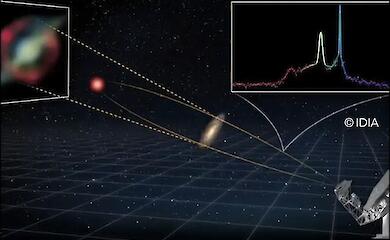
Astronomers have detected a signal that has been travelling towards Earth for over 8 billion years

News about war

Ukrainians have to help wounded during Russian shelling on their own


Pro-Russian march with St. George ribbons and Night Wolves allowed in Vienna

"Grow up!" - Budanov named the main risk for preserving independent Ukraine

