

Space storms have coloured Japan's skies red


A rare red glow has appeared several times over Japan - not the bright green "curtains" usually associated with the aurora borealis, but a faint reddish haze near the horizon. Such phenomena are easy to miss, but for scientists they turned out to be an important clue about what happens to the Earth's magnetic field during space storms.
Researchers from Hokkaido University and the Okinawa Institute of Science and Technology studied five such events observed from Hokkaido from June 2024 to March 2025. It turned out that the red lights rose unusually high - about 500 to 800 kilometres above the Earth. At the same time, the magnetic storms themselves looked only moderate according to standard indices.
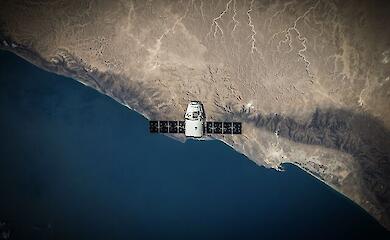
This is important not only for lovers of beautiful skies. Such auroras can indicate a strong compression of the magnetosphere - the Earth's protective magnetic shell. And changes in the upper atmosphere affect satellites, especially those in low orbits.
Details
Polar lights occur when charged particles coming from the Sun interact with the Earth's magnetic field and atmosphere. Near the poles, such phenomena are bright and frequent. At lower latitudes, including Japan, auroras are much less common and usually look different - more often as a red glow.
The red colour is associated with oxygen atoms high in the atmosphere. When charged particles transfer energy to them, the oxygen then emits light. Under normal conditions, low-latitude red lights are more likely to occur at altitudes of about 200 to 400 kilometres. The new work estimates them to be higher - over 500 kilometres, and in some cases up to 800 kilometres.
Scientists attribute this to an unusually strong compression of the magnetosphere. During the studied events to the Earth came dense streams of solar wind - streams of charged particles from the Sun. They pressed on the magnetosphere more strongly than usual, "compressing" it closer to the planet.
Because of this, the upper layers of the atmosphere could heat up and expand, and the area where the red glow is born rose higher. At the same time, such storms did not look extreme according to the usual indices. The researchers suggest that some of the indices may have underestimated the real strength of what was happening because charged particles were leaving the system differently than usual.
It wasn't just satellite data that was used for the analysis. Photographs of ordinary observers from different parts of Japan played a big role. By the angle at which the aurora was seen from different locations, the scientists were able to reconstruct the height of the luminous structures along the magnetic field lines.
This approach shows that citizen science is becoming an important part of space weather observations. Rare auroras can appear where there isn't a dense network of professional instruments, but where there are people with cameras and smartphones.
Why it matters
The red glow over Japan is not only a beautiful phenomenon. It helps us understand how the Earth responds to solar matter and energy flows. If the usual indices show a storm as moderate, but the atmosphere and magnetosphere behave as if the event is stronger, this is important to consider in forecasts.
Space weather affects satellites, communications, navigation, and power systems. When the upper atmosphere heats up and expands, satellites in low Earth orbit experience more drag. Their orbits can change faster than expected.
This is especially true now that the number of satellites in low Earth orbit is growing rapidly. The more accurately scientists understand such events, the better satellite risks can be predicted and planned for.
Background
Japan is much further south than regions where auroras are regularly observed. Therefore, every appearance of red lights over Hokkaido or other parts of the country attracts the attention of astronomers and sky enthusiasts.
In recent years, such events have been increasingly studied. For example, observations of the red glow over Hokkaido on 1 December 2023 have already shown that even a magnetic storm that is not normally strong can produce a noticeable red glow if the solar wind was particularly dense and strongly compressed the magnetosphere.
The new work continues this line of thinking. It shows that faint red glows over Japan may not just be a rare beauty, but an indicator of processes that standard space storm estimates do not fully capture.
Source
Tomohiro M. Nakayama, Ryuho Kataoka, "Faint red auroras as seen from Japan associated with intense magnetospheric compression", Journal of Space Weather and Space Climate, 2026.
The study analysed five low-latitude red auroras observed from Hokkaido from June 2024 to March 2025. The authors compared satellite data and photographs of observers from different parts of Japan. They concluded that the auroras occurred during magnetic storms moderate by standard indices, but were accompanied by strong magnetospheric compression and rose to altitudes of more than 500 kilometres.
Mykola Potyka has a wide range of knowledge and skills in several fields. Mykola writes interestingly about things that interest him.
Related news

Traces of the earliest asteroid impact on Earth have been found in Australia

A mysterious signal has been detected from the surface of Titan and Pluto
Popular news

A medieval bathhouse in Morocco has kept its secret for a thousand years


Scientists have discovered why one brother was buried in a lavish grave whilst the other was buried on the outskirts of the cemetery
Astronomers have detected a signal that has been travelling towards Earth for over 8 billion years
News about war

Ukrainians have to help wounded during Russian shelling on their own


Pro-Russian march with St. George ribbons and Night Wolves allowed in Vienna

"Grow up!" - Budanov named the main risk for preserving independent Ukraine

