


Art some 17,000 years old has been found on the wall of a Welsh cave


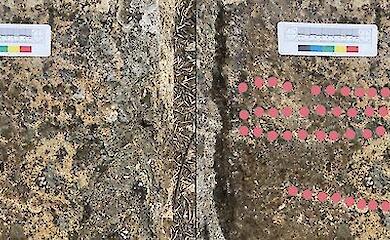
In Bacon Hole Cave on the Gower Peninsula in South Wales, red stripes on the wall, which were first noticed in 1912, have been re-examined. At the time, they were recognised as Britain's oldest cave art, but later many scientists decided that they were just ordinary mineral efflorescence.
New work changes the picture again: analyses have shown that the red pigment was probably applied by humans.
Researchers estimate that the images could be around 17,000 years old. If this dating is confirmed, the find will be one of the oldest examples of cave art in Britain and possibly north-west Europe.
Details
Bacon Hole is a well-known cave on the coast of South Wales. Its walls are covered with both modern inscriptions and older traces. The most important red stripes for the new study are in the side chamber of the cave. It was these that Professor William Sollas and archaeologist Henri Breuil studied in the early 20th century.
In 1912, they assumed that this is Palaeolithic art - that is, drawings of people of the Stone Age. But by 1928 this version was already rejected: the red marks were considered to be natural stains left by minerals on the wall. After that, the story almost disappeared from public discussion.
A modern team of researchers returned to these traces in 2022-2024. The scientists used D-Stretch digital image processing, which enhances faint colours and helps them see the almost vanished traces on the stone. So they looked at streaks, finger dots and traces of splattered pigment.
Then the experts took microscopic samples of the red substance and studied its composition. The analysis showed that this is not a random mineral plaque, but haematite - a red glandular pigment that was often used in ancient art. In the article, the authors explicitly write that the coloured surface is the result of human action: the hematite was deliberately applied to the wall.
It's more complicated with age. There is no organic material in the paint, so radiocarbon analysis is not appropriate. Instead, the researchers dated calcite, a white mineral crust that has grown over time on top of the red marks. If the crust lies over the pigment, then the paint itself is older than that crust.
One of the samples gave a minimum age of about 15,700 years at a 95 per cent confidence interval; in popular retellings, this is usually rounded up to about 17,000 years. Other samples were younger, which the authors attribute to a later build-up of new layers of calcite due to water running down the wall.
Why it's important
This find is important not because it reveals a complex animal or human pattern on the wall. Instead, it is about simple red stripes and traces of pigment. But for Britain, it could still be the rarest evidence of Ice Age human art.
If the dating is confirmed, Bacon Hole will be one of the key sites for understanding when people returned or more actively developed the land after the harsh glacial conditions. At this time, the climate was changing, glaciers were retreating, and areas that had long been difficult to live in were becoming accessible again to hunter-gatherers.
The material also shows how old archaeological disputes can be resolved by new methods. What looked like dubious stains a hundred years ago can now be verified by chemical analysis, digital image processing and mineral layer dating.
Background
Cave art is more commonly associated with France and Spain - Lascaux, Altamira and other famous monuments. There are far fewer such finds in Britain, so every new or reconfirmed cave painting carries a lot of weight.
Bacon Hole is also interesting because its find has been known for over a century. It was not discovered from scratch, but actually rediscovered: researchers went back to the controversial red traces and checked them with modern methods.
So far, the main conclusion is as follows: the red stripes were most likely made by humans. But the exact age requires further verification. Therefore, it is more correct to say that in the Welsh cave found a possible ancient cave painting of Britain, and not finally closed the question.
Source
Research: George H. Nash et al, 'Rediscovered Late Upper Palaeolithic Painted Imagery at Bacon Hole, Gower Peninsula, South Wales', Quaternary, 2026.
An independent researcher, interested in archaeology and sacred geography. He researches them and writes about them.
Related news
Scientists have discovered how crested geese were bred in the 17th century

Scientists have discovered why one brother was buried in a lavish grave whilst the other was buried on the outskirts of the cemetery
Scientists have discovered why the Incas sacrificed children
Archaeologists have discovered an ancient curse containing the names of enemies and demons
Popular news

A medieval bathhouse in Morocco has kept its secret for a thousand years
Scientists have discovered why one brother was buried in a lavish grave whilst the other was buried on the outskirts of the cemetery

Astronomers have detected a signal that has been travelling towards Earth for over 8 billion years

News about war

Ukrainians have to help wounded during Russian shelling on their own


Pro-Russian march with St. George ribbons and Night Wolves allowed in Vienna

"Grow up!" - Budanov named the main risk for preserving independent Ukraine

