
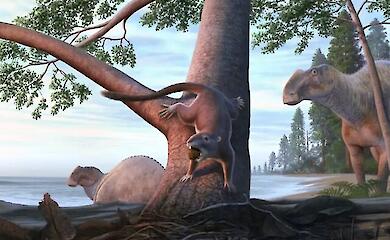

Duck beak, venom and snake eggs - and now another "bird" feature of the platypus


The platypus already looks like an animal assembled from different species: beak like a duck, tail like a beaver, eggs like reptiles and poisonous spurs in males. Now scientists have found another oddity - they have discovered microstructures in the platypus' fur that were previously thought to be characteristic of birds.
And the best part: why he needs them, no one knows for sure yet.
Details
The researchers studied melanosomes - tiny structures inside cells that contain melanin. This pigment is responsible for the colour of skin, fur, hair and feathers.
In mammals, these structures are usually solid. In birds, however, there are more unusual shapes, including hollow ones. They can be involved in creating bright and shimmering colours, such as in feathers.
When scientists studied the coat of a platypus, they found something unexpected: its melanosomes were hollow and spherical. This shape had never been found in any mammal before.
The researchers checked the data on other animals, including echidnas, marsupials, rodents and primates. But they found nothing similar.
At the same time, the platypus does not have a bright iridescent coat - it remains the usual dark brown colour. Therefore, scientists believe that this feature may not be related to colouring, but to some other function.
Why it matters
The platypus has long been considered one of the most unusual animals on Earth. It belongs to egg-laying mammals, can sense prey's electrical signals, and males have venomous spurs.
The new finding adds another mystery to that list.
It shows that even well known animals can still have features that do not fit into the usual ideas about mammals. Which means the evolution of the platypus may be even more unusual than thought.
Background
When the first stuffed specimen of the platypus was brought to Europe in the 18th century, some naturalists suspected a fake: the animal looked too strange.
Since then, the platypus has regularly surprised biologists. A new study shows that its oddities are not limited to appearance - even the microscopic structure of the fur was unusual.
Source
The study is published in the journal Biology Letters (2026). The scientists described unique hollow spherical melanosomes in the platypus' coat and found no similar structures in other mammals studied.
Maria Grynevych, project manager, journalist, co-author of Guidebook Sacred Mountains of the Dnieper Region, Lecture Course: Cult Topography of the Middle Dnieper Region.
Related news
A 15-year-old cat is roughly equivalent to a human aged around 80


Scientists have explained why the poo emoji looks the way it does
Brave, cautious and quick-witted: monkeys have ‘personalities’ too
Popular news

A medieval bathhouse in Morocco has kept its secret for a thousand years


Scientists have discovered why one brother was buried in a lavish grave whilst the other was buried on the outskirts of the cemetery

Astronomers have detected a signal that has been travelling towards Earth for over 8 billion years

News about war

Ukrainians have to help wounded during Russian shelling on their own


Pro-Russian march with St. George ribbons and Night Wolves allowed in Vienna

"Grow up!" - Budanov named the main risk for preserving independent Ukraine

