

El Niño is back – and could be the strongest in 70 years of records
- Home
- Events
- Natural disasters
- El Niño is back – and could be the strongest in 70 years of records


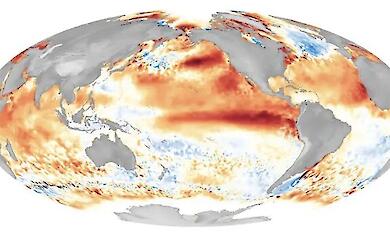
The US National Oceanic and Atmospheric Administration (NOAA) has officially confirmed that El Niño has formed. And this time, scientists are not ruling out the worst-case scenario — the current cycle could go down in history as one of the strongest since 1950.
NOAA estimates the probability that the Pacific Ocean’s surface temperature will exceed the critical threshold of +2°C at 63%; the agency considers this level to be a very significant event. Carlo Buontempo, Director of the European climate service Copernicus, puts it bluntly: the chances of a severe or even record-breaking event are now very high.
Details
El Niño is the warming of the Pacific Ocean’s surface in its central and eastern regions. One might wonder: where is the Pacific Ocean, and where, for example, are India or the Amazon? But the Earth’s climate system is such that warmth in one place alters wind patterns and precipitation patterns literally all over the world.
The typical consequences of a strong El Niño are well known: droughts in the Amazon, Indonesia and Australia, disruptions to the monsoon rains over India, and a disruption to the usual distribution of rainfall across the tropics. El Niño usually peaks towards the end of the year, but its impact on global temperatures lasts longer — ocean heat is slowly released into the atmosphere, and the hottest months generally occur the following year.
Climatologists warn that global temperature records could be broken as early as 2026 — but 2027 looks truly alarming.
For tens of millions of people, this is not an abstract forecast. In Central America — in the so-called ‘Dry Corridor’, which includes parts of Guatemala, Honduras, El Salvador and Nicaragua — governments have already raised the alert level. Guatemala has pre-positioned 1.1 million food parcels in anticipation of a food emergency. Mohamed Adou, director of the African climate centre Power Shift Africa, has described what is happening as a “death knell”: for millions of people, this means crop failures, the loss of harvests and rising food prices.
Why this matters
There have been only five super-strong El Niños since 1950 — in 1972–73, 1982–83, 1997–98, 2015–16 and 2023–24. Some computer models are already indicating that the current event could become one of the most intense in recorded history.
The planet is already experiencing a series of abnormally hot years. Add a powerful El Niño to this, and we risk seeing temperature records unprecedented in modern history. Mark Alessi of the Union of Concerned Scientists warns that the combination of climate change and a potential super El Niño is a ‘terrible combination’ capable of ‘easily’ pushing global temperatures to record highs.
Background
El Niño is a natural cycle that humanity has been observing for a long time. Its periodicity has been studied, and its consequences are generally predictable. But climatologists are increasingly pointing out that, against the backdrop of global warming, the usual patterns are changing. There is evidence that human-induced climate change is making El Niño events more intense — although it is still difficult to prove this trend conclusively.
The previous El Niño in 2023–2024 was one of the five strongest on record. However, on its own, it was weaker than the events of 1982–83 and 1997–98, which complicates conclusions about the influence of climate on the intensity of El Niño. At the same time, even a relatively moderate event is unfolding today in a world transformed by climate change — with additional heat and moisture in an already overheated atmosphere and oceans. The current El Niño is occurring against the backdrop of one of the warmest periods in recorded history.
UN Secretary-General António Guterres has called on world governments to view the impending phenomenon “as an urgent climate warning”. In his words, El Niño “adds fuel to the fire of a warming world”.
Source
This article is based on an official statement from NOAA (the US National Oceanic and Atmospheric Administration), comments by Carlo Buontempo, Director of the European climate service Copernicus, assessments by Power Shift Africa and the Union of Concerned Scientists, and a statement by UN Secretary-General António Guterres.
Mykola Potyka has a wide range of knowledge and skills in several fields. Mykola writes interestingly about things that interest him.
Related news
The world is preparing for a new El Niño: what it could threaten with

The Pacific Ocean is signalling: El Niño could start as early as this year


Popular news


A medieval bathhouse in Morocco has kept its secret for a thousand years


Scientists have discovered why one brother was buried in a lavish grave whilst the other was buried on the outskirts of the cemetery
Astronomers have detected a signal that has been travelling towards Earth for over 8 billion years
News about war

Ukrainians have to help wounded during Russian shelling on their own


Pro-Russian march with St. George ribbons and Night Wolves allowed in Vienna

"Grow up!" - Budanov named the main risk for preserving independent Ukraine

