


The world is preparing for a new El Niño: what it could threaten with
- Home
- Events
- Natural disasters
- The world is preparing for a new El Niño: what it could threaten with


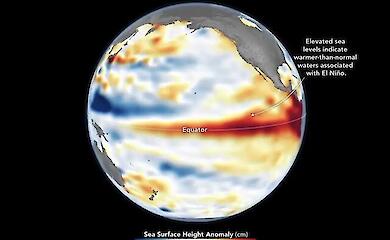
In the Pacific Ocean, conditions are again forming for El Niño, a climate phenomenon that can change weather around the world. It is associated with an unusual warming of surface waters in the equatorial Pacific Ocean and a rearrangement of atmospheric circulation.
According to the latest NOAA forecast, there is an 82% chance of an El Niño transition as early as May-July 2026, and by the Northern Hemisphere winter of 2026-2027, the probability of El Niño persisting is estimated to be about 96%.
Important: it is not yet possible to say with certainty that this will be exactly a "super El Niño" or one of the strongest episodes in history. Climate models indicate a high probability of the phenomenon itself, but its future strength remains uncertain. Nature separately emphasises: El Niño is indeed expected, but understanding its intensity will come later.
Details
El Niño is the warm phase of the ENSO climate cycle. It has three states: the neutral phase, the La Niña cold phase and the El Niño warm phase.
In normal years, trade winds drive warm water across the equatorial Pacific Ocean westwards towards Indonesia and Australia. Colder deep waters rise off the coast of South America. These are rich in nutrients, so they support fish stocks, especially off the coasts of Peru and Ecuador.
During El Niño, this system is disrupted. The waters in the central and eastern Pacific become warmer than usual, the trade winds weaken, and the usual rain and drought zones shift. The phenomenon therefore affects not only the ocean but also the atmosphere.
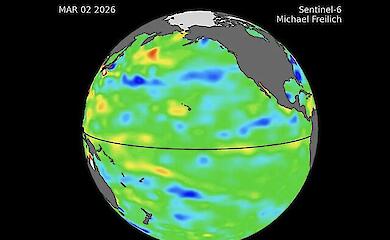
The World Meteorological Organisation reports that sea surface temperatures in the equatorial Pacific are rising rapidly, indicating a likely return of El Niño as early as May-July 2026. WMO also warns of a near global dominance of above normal temperatures in the coming months.
The effects of El Niño depend on the region. In some places it increases the risk of heavy rainfall and flooding, while in others it increases the risk of droughts, heat waves and crop problems. According to WMO, past El Niño episodes have been associated with heavier rainfall in parts of the Americas, East Africa and Central Asia, and drier conditions in Australia, Indonesia and parts of South Asia.
For global temperatures, El Niño is also important. It temporarily adds heat to already existing anthropogenic warming. It is the combination of a powerful El Niño 2023-2024 and long-term climate change that helped make 2024 the hottest year on record.
Why it matters
El Niño does not mean it will get equally hot or dry everywhere. It's not "one weather for the whole planet." It changes the balance in the ocean and atmosphere, and then each region gets its own set of consequences.
For some countries, it's the risk of heavy rains, floods and landslides. For others, it's drought, heat waves, fires, water and agricultural problems. Especially vulnerable are regions where the economy depends on crops, fisheries, hydropower or seasonal rains.
If El Niño proves strong, it could affect 2027 as well. Usually, the maximum effect on global temperature does not occur immediately, but with a delay. So a strong episode in 2026 could increase the risk of new temperature records next year.
But it is important not to overreact here. The mere fact of El Niño does not mean an automatic catastrophe. Its consequences depend on the strength of the phenomenon, the timing of its development, the state of the Indian Ocean, the Atlantic, regional circulations and the overall background of global warming.
Background
The name El Niño originated with Peruvian fishermen in the 19th century. They noticed that sometimes unusually warm water appeared off the coasts of Peru and Ecuador. This often occurred close to Christmas, so they named the phenomenon El Niño - "the boy", or "the baby", in reference to the Christ child.
It later became clear that this was not just a local warming of the water off the coast of South America. El Niño is linked to a large system of ocean-atmosphere interactions that spans the tropical Pacific Ocean and affects weather far beyond.
The strongest El Niño episodes in the 20th and 21st centuries, including events in 1982-1983, 1997-1998 and 2015-2016, were accompanied by notable weather anomalies: heavy rains in some regions, droughts in others and spikes in global temperatures. That's why climate scientists are keeping a close eye on the development of the new episode.
Maria Grynevych, project manager, journalist, co-author of Guidebook Sacred Mountains of the Dnieper Region, Lecture Course: Cult Topography of the Middle Dnieper Region.
Related news
El Niño is back – and could be the strongest in 70 years of records

The Pacific Ocean is signalling: El Niño could start as early as this year
Popular news


A medieval bathhouse in Morocco has kept its secret for a thousand years

Scientists have discovered why one brother was buried in a lavish grave whilst the other was buried on the outskirts of the cemetery

Astronomers have detected a signal that has been travelling towards Earth for over 8 billion years
News about war

Ukrainians have to help wounded during Russian shelling on their own


Pro-Russian march with St. George ribbons and Night Wolves allowed in Vienna

"Grow up!" - Budanov named the main risk for preserving independent Ukraine

