
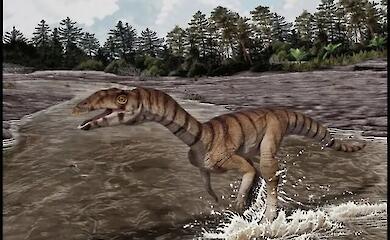

Salamander named after Quetzalcoatl: an ancient relative of the axolotl has been described in Mexico


A new fossil species of salamander, close to the famous axolotl, has been described in Mexico. The animal was named Ambystoma quetzalcoatli in honour of Quetzalcoatl, one of the most important deities of Mesoamerican mythology, who was depicted as a feathered serpent.
The fossils were found in the state of Hidalgo, about 100 kilometres north of Mexico City. In the Pliocene, several million years ago, there was an ancient lake called Santa Maria Amahac. It was in its sediments that complete and articulated salamander skeletons were preserved - a rare feat for such fragile animals. The study is published in Palaeontologia Electronica.
Details
The modern Mexican axolotl is known for an unusual feature: it can remain a "cub" as an adult. That is, it does not undergo a complete transition to a terrestrial form, retains an aquatic lifestyle and the external features of a larva.
The new fossil species was also neotenic. Simply put, the adult animal retained juvenile features, like the modern axolotl. But the skull structure of the specimens found was unusual enough to separate them into a separate species.
Scientists studied several specimens from the Sanctorum locality in the Santa Maria Amahac region. The specimens were compared to modern Mexican Ambystoma species using prepared skeletons and computed tomography data. This approach allowed them to see details of the bone structure and to verify that the species in front of them was not an already known species, but a new fossil form.
Most importantly, these fossils were preserved almost intact. Salamanders have thin and brittle bones, so complete articulated fossil skeletons are rare. For Mexico, this is also the first formally described fossil salamander species, and the oldest known member of the Ambystoma genus in the country.
Why it's important
The find helps us better understand how the group of salamanders to which the modern axolotl belongs evolved. Today, Mexico is one of the centres of diversity for Ambystoma salamanders, but their ancient history in the region was less well known.
Ambystoma quetzalcoatli shows that this lineage existed in Mexico as early as the Pliocene. The study authors believe the new species was close to modern species from the central Trans-Mexican Volcanic Belt and possibly related to the tiger salamander group.
Background
The axolotl became famous for more than just its appearance. The modern Mexican axolotl can regenerate limbs, tail and some other tissues, so it is actively studied by biologists. But the new discovery does not speak directly about the regeneration of the ancient species: on the fossils can not confidently judge how well he regenerated tissues.
But from the bones we can understand other things: where such animals lived, what their environment looked like and how long ago this group was represented in Mexico. Judging by the data from Santa Maria Amahac, there was an intermountain lake there in the late Pliocene with a rich flora and fauna.
The name quetzalcoatli links the find to the cultural context of Mexico. Quetzalcoatl is not just a beautiful mythological image, but an important symbol of the region. Therefore, the name of the new species emphasises the place where the find was made.
Source
Jorge A. Herrera-Flores, María Patricia Velasco-de León, "Ambystoma quetzalcoatli sp. nov., a new species of fossil axolotl (Caudata: Ambystomatidae) from the Pliocene of Santa María Amajac, Hidalgo, Mexico", Palaeontologia Electronica, 2026.
An independent researcher, interested in archaeology and sacred geography. He researches them and writes about them.
Related news
Scientists have discovered how crested geese were bred in the 17th century


A 15-year-old cat is roughly equivalent to a human aged around 80

Scientists have discovered why one brother was buried in a lavish grave whilst the other was buried on the outskirts of the cemetery
Scientists have discovered why the Incas sacrificed children
Popular news

A medieval bathhouse in Morocco has kept its secret for a thousand years
Scientists have discovered why one brother was buried in a lavish grave whilst the other was buried on the outskirts of the cemetery

Astronomers have detected a signal that has been travelling towards Earth for over 8 billion years

News about war

Ukrainians have to help wounded during Russian shelling on their own


Pro-Russian march with St. George ribbons and Night Wolves allowed in Vienna

"Grow up!" - Budanov named the main risk for preserving independent Ukraine

