
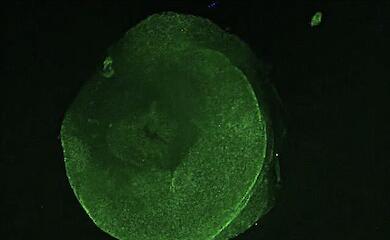

Two legs, a beak and small hands: a strange relative of crocodiles found


Paleontologists have described a new species of ancient animal that breaks the usual idea of the crocodile family. It walked on two legs, had small forelimbs and a toothless mouth with a beak. It was not a dinosaur, but a representative of the archosaur lineage related to crocodiles.
The new species was named Labrujasuchus expectatus. Its remains were found at Ghost Ranch in New Mexico, one of the most famous Triassic fossil sites in the United States. The animal lived about 212 million years ago, in the late Triassic, when dinosaurs were just beginning to become a prominent force on land.
Details
Labrujasuchus expectatus belonged to the Shuvosauridae. This is a group of ancient relatives of crocodiles that could resemble bipedal predatory dinosaurs in appearance: long hind legs, small forelimbs, light body and travelling on two legs.
Most unusual is the combination of traits. Modern crocodiles are usually associated with four legs, a powerful mouth and teeth. Labrujasuchus was the opposite: it travelled on two legs, had small arms and a toothless beak. So it looked about as we would least expect a crocodile relative to look.
Scientists compare its appearance to ornithomimosaurs, the later dinosaurs of the Cretaceous period, which resembled ostriches in body shape. But similarity doesn't mean close kinship. It is an example of convergent evolution: different groups of animals independently arrive at a similar body structure if a similar lifestyle proves successful.
The name, too, refers to the place of discovery. Labrujasuchus is related to the old Spanish name Ghost Ranch - Ranchos de los Brujos, "witches' ranch", and the suchus part means "crocodile". The species name expectatus can be translated as "expected": palaeontologists assumed that there must be an intermediate Schuvosauridae between the already known finds in this region.
Why it's important
This find is important not because scientists have found "another ancient crocodile". It shows that the crocodilian lineage in the past was much more diverse than it appears from modern species.
Today, crocodiles, alligators and gavials look fairly recognisable: aquatic or semi-aquatic predators with long mouths and strong tails. But their ancient relatives may have been very different - running on two legs, having beaks and occupying ecological roles that later we more often associate with dinosaurs and birds.
The Triassic was a time of experimentation. After the mass extinction at the end of the Permian, ecosystems were being rebuilt and different groups of reptiles were quickly adopting new ways of living. Labrujasuchus is a good example of such an "evolutionary experiment".
Background
Ghost Ranch has long been known as a rich Triassic fossil site. Remains of ancient reptiles, early dinosaurs, and other animals that lived during the period before the complete dominance of dinosaurs have been found there for decades. The new species is described as part of Hayden Quarry's ongoing research at Ghost Ranch.
Such finds are also important to palaeontologists because they fill in the gaps between already known species. Labrujasuchus expectatus has become one of the few Schuvosauridae described and helps to better understand how this unusual group of crocodile relatives changed in the Late Triassic.
Source
Alan H. Turner et al., "A new shuvosaurid (Archosauria, Poposauroidea) from the Late Triassic (Norian) Hayden Quarry of New Mexico, U.S.A.", Journal of Vertebrate Paleontology, 2026.
An independent researcher, interested in archaeology and sacred geography. He researches them and writes about them.
Related news
Scientists have discovered how crested geese were bred in the 17th century

A 15-year-old cat is roughly equivalent to a human aged around 80

Scientists have discovered why one brother was buried in a lavish grave whilst the other was buried on the outskirts of the cemetery
Scientists have discovered why the Incas sacrificed children
Popular news
A medieval bathhouse in Morocco has kept its secret for a thousand years
Scientists have discovered why one brother was buried in a lavish grave whilst the other was buried on the outskirts of the cemetery
Astronomers have detected a signal that has been travelling towards Earth for over 8 billion years

News about war

Ukrainians have to help wounded during Russian shelling on their own


Pro-Russian march with St. George ribbons and Night Wolves allowed in Vienna

"Grow up!" - Budanov named the main risk for preserving independent Ukraine

