
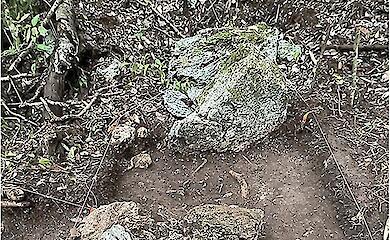

The asteroid that killed the dinosaurs warmed the Earth's interior for millions of years


The asteroid that struck Earth some 66 million years ago and is linked to the demise of non-bird dinosaurs didn't just create a disaster on the surface. A new study shows that after the impact, a hot underground system of water emerged under the Chicxulub crater in Mexico for millions of years.
It's not about scientists finding ancient life there. They found out something else: the conditions beneath the crater had been favourable for microbes for a very long time. Hot rocks, cracks and water together formed a hydrothermal system - simply put, an underground network of hot water running through the split rocks.
According to calculations and rock analyses, this system worked for at least about 8 million years. That's about four times longer than previous estimates suggested, and the longest such time for an impact crater on Earth that has been documented.
Details
The Chicxulub crater was created after a large asteroid impacted the area of what is now the Yucatan Peninsula. The crater itself is about 200 kilometres in diameter. The impact was so powerful that it melted and crushed rocks deep below the surface.
After the impact, the hot rocks began to interact with the water. The water travelled through the cracks, heated up and changed the composition of the minerals. Such systems are called hydrothermal systems. On Earth, they are found, for example, near volcanoes and at the bottom of the ocean. Microorganisms that don't need sunlight can live in them.
To understand how long such a system existed beneath Chicxulub, scientists studied rock samples from drill core M0077A. This core was obtained during an international expedition to the crater. In the rocks found potassium-bearing feldspar - a mineral that was formed after the impact, when hot water circulated through the cracks.
The age of the minerals was determined by argon-argon dating. It helps to understand when a mineral was formed or changed by heat. The dates turned out to range from 66 to 58 million years ago. That gave scientists a window of about 8 million years after impact.
The researchers then used computer modelling. It showed that such a long operation of the underground system is possible if the rocks were sufficiently fractured and porous, and the heat from the impact was retained for a long time. According to the model, water movement almost stopped after about 8 million years.
Simply put: the asteroid heated up the interior a lot, fracturing the rocks and opening up pathways for water to flow downwards. The water circulated, heated up, and created an environment under the crater where microbes could theoretically exist.
Why it matters
At first glance, an asteroid impact is all about destruction. But for microbial life, such events can be more than just a catastrophe. Deep down, they can create warm, sheltered places with water and chemicals.
This is important for understanding the early Earth. In the first epochs of the planet's history, major impacts occurred more frequently than they do now. If they were followed by long-lived hot systems underground, they may have been places where life was preserved or where important chemical reactions took place.
But the conclusion must be phrased carefully. The scientists did not prove that microbes actually lived under the Chicxulub. They have shown that conditions that might have been suitable for microbial life existed there for a long time. In the paper itself, the authors explicitly note that it is difficult to prove microbial settlement of ancient impact craters.
Background
Hydrothermal systems have long interested scientists because they may be linked to the origin and survival of life. There's heat, water, minerals and chemical reactions. For simple organisms, that may be enough.
Previously, it was thought that the system beneath Chicxulub Crater could have persisted for about 1.5 to 2.3 million years. The new work shows a longer time frame - at least about 8 million years. This changes the idea of how long impact craters can remain potentially habitable.
There's also a cosmic context. Mars, the Moon and other solar system bodies have many impact craters. If there was water there in the past, large impacts could create similar hot underground environments. Such craters could therefore be interesting targets for searching for traces of ancient life.
Source
Research: Annemarie E. Pickersgill and co-authors, A long-lived impact-generated hydrothermal system at the Chicxulub impact structure, Communications Earth & Environment, 2026.
Mykola Potyka has a wide range of knowledge and skills in several fields. Mykola writes interestingly about things that interest him.
Related news

A feathered dinosaur with four "wings" has been found in China

Palaeontologists have described a dinosaur with heron-like behaviour
Scientists have described an ancient marine predator the size of a bus
Popular news

A medieval bathhouse in Morocco has kept its secret for a thousand years
Scientists have discovered why one brother was buried in a lavish grave whilst the other was buried on the outskirts of the cemetery

Astronomers have detected a signal that has been travelling towards Earth for over 8 billion years

News about war

Ukrainians have to help wounded during Russian shelling on their own


Pro-Russian march with St. George ribbons and Night Wolves allowed in Vienna

"Grow up!" - Budanov named the main risk for preserving independent Ukraine

